
From role to answer, one pipeline.
Configure the role, run one sitting, score every fit, decide with evidence — then interview on the same record. No stitched vendors, no hand-offs, no contradictory scores. Here is the whole path.
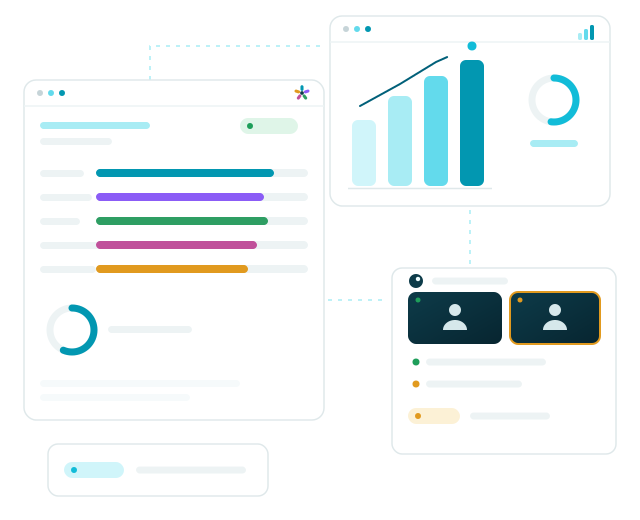
Five moves from role to hire
Each one auditable, none of them a black box — and the interview is part of the pipeline, not an afterthought. One candidate record carries the whole journey, invite to offer; nothing is re-keyed between steps.
1 · Configure
Pick the role and choose the instruments — profiling, cognition, skills, judgment, values — from role templates or your own job descriptions. Set the integrity tier per campaign, from none to full verification.
2 · Assess
Candidates complete everything in one browser sitting — nothing to install. Difficulty adapts in real time: profiling alone runs under 30 minutes, a full battery with skills 60–90.
3 · Score
Responses become scored evidence — 30 personality facets, benchmarked aptitude, expert-keyed judgment, verified integrity — resolved against your role's demands, not a population average.
4 · Decide
Three answers per candidate — perform, fit, stay — with the reasoning attached and a report the panel can actually read.
5 · Interview
The report ends with the exact probes worth the panel's forty-five minutes. Schedule, interview and rubric-score on the same candidate record.
Every hire is three questions.
Interviews only ever answer one.
Selection science has asked the same three questions for fifty years — can they do it, will they do it, will they fit. 5Profiler measures all three, and a fourth the research says your CFO cares about most: will they stay. Together they resolve into the three answers on every report.
Can they do it?
The ceiling — what they’re able to do at their best.
Will they do it?
The default — how they actually behave when nobody is coaching.
Will they fit — and stay?
The direction — what they steer by, and what keeps them.
Six instruments. Five fits. Three answers.
One instrument per fit — so no score is a relabel of another — and a sixth, work values, that feeds the Stay answer directly. Every instrument runs standalone with its own report; run two or more and they resolve into a single candidate view.
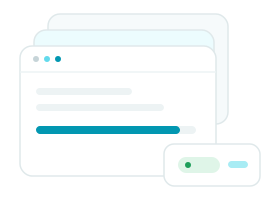
One panel-ready answer per candidate — interview probes attached, minutes after completion.
What the candidate actually experiences
Two thousand candidates take the assessment in a campus season — and all of them talk about it. The sitting is built like it matters.
Six instruments in a single flow that adjusts to the candidate — no padding, no demoralising walls of items.
Runs in the browser — even the dual-camera side view uses the candidate’s own phone, no app install.
Realistic scenarios and honest trade-offs — nothing to memorise, nothing to game.
Every flag is reviewed by a person; no candidate is ever auto-rejected by a score.
Proctoring, when the campaign calls for it, is disclosed before consent: ID checks at check-in, live monitoring at the tier you chose, and an evidence clip behind every flag — reviewed by a human. See the integrity tiers.
Built to run hiring, not just tests
Campaigns at any volume
Invite ten candidates or ten thousand — bulk upload, group tagging, automated reminders and live completion dashboards keep the funnel moving without a spreadsheet in sight. Per-candidate credentials mean no shared links and no forwarded invites.
Plays well with what you already run
5Profiler slots into your hiring stack instead of replacing it — answers and reports flow to the systems you already work in.
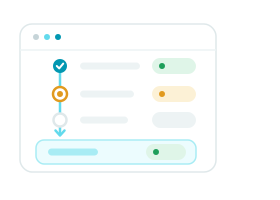
Access, governed
Five org roles with per-permission gates and a full audit trail — everyone sees exactly their slice.
HRIS sync
Darwinbox, Keka, BambooHR and Workday via a managed sync layer — no duplicate entry.
Exports that behave
Structured exports for your BI stack, PDFs for the panel.
See the evidence on your next hire.
A 30-minute walkthrough with your roles, not a canned deck — and a sample report to keep.