
From score to structured interview.
The assessment is half the decision. 5Profiler runs the other half too: shortlist from the scorecard, schedule in a click, interview on evidence-anchored probes, and score against a rubric — all on the same candidate record.

The interview starts on the scorecard, not in a spreadsheet
Most teams assess in one tool, export a CSV, and rebuild the shortlist in another. On 5Profiler the campaign scorecard is the interview queue.
1 · Shortlist
Sort the campaign scorecard by the answer that matters — role fit, integrity-cleared, the facets the job actually demands — and select the candidates worth a panel's hour.
2 · Schedule
Schedule interviews for one candidate or a whole shortlist at once. Invites, reminders and join links go out branded and on time — no calendar archaeology.
3 · Interview
The panel walks in holding the candidate's report and its probes. The conversation starts where the assessment left off, not from “tell me about yourself”.
4 · Decide
Rubric scores land on the same record as the assessment. One candidate, one file, one defensible decision — assessment and interview reconciled on a single page.
AI drafts the interview.
Your people approve it.
The scorecard your panel rates against is drafted by AI from the role’s real work — its actual tasks, the behaviours the occupation demands, the values you declared — then made to survive two independent reviews before a human approves a single question.
- Grounded in the role’s real work — questions wrapped in the occupation’s actual tasks, not generic prompts.
- Two gates before any human time — a mechanical validator enforces scoring discipline; a second, independent AI reviewer tries to tear every item apart.
- Humans hold the pen — nothing is scoreable until your team approves it, item by item; rework or retire questions the same way.
- Wording frozen at the interview — every rating permanently keeps the exact question it was scored against, even if the rubric changes later.
Product interface · animated recreation, sample data
Every interview starts where the assessment left off
Each candidate report closes with interview probes generated from that candidate's own results — the places where instruments disagree, the facets that sit far from the role's demands, the claims worth pressure-testing in person.
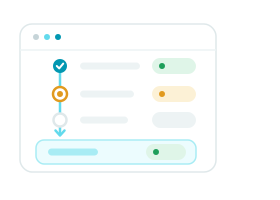
- Probes from disagreement — when the situational judgment score and the personality profile pull apart, that tension becomes the agenda.
- Written for interviewers, not psychometricians — each probe is a question the panel can ask verbatim, with a note on what a strong answer sounds like.
- Per candidate, not per role — two finalists for the same role get different probes, because they carry different evidence.
Structure the panel can actually follow
Fifty years of selection research says the structured interview is one of the strongest predictors hiring has — and that its validity lives or dies in the discipline of the process. 5Profiler builds that discipline in.
Behaviorally anchored rubrics — AI-drafted, human-approved
The AI foundry drafts a full rubric from the role’s real work — its actual tasks, measured behavioural demands, your declared values — and every item must survive a mechanical validator plus an independent AI review before your team approves it. Panels rate what they heard against concrete behavioral anchors, not a gut number, and every rating permanently keeps the exact question it was scored against.
Independent scoring first
Each panelist scores independently before the group discusses — the design the evidence says protects ratings from the loudest voice in the room.
Panel room, one record
Panel chat and private notes live with the interview, and the discussion leaves a written record attached to the candidate file — not a thread lost in someone's inbox.
Scores combine by rule
Competency weights are fixed when the rubric is designed, and the composite is computed from the written ratings — the combination step stays mechanical, the way the research says it should.
Bulk scheduling
Move an entire shortlist from scorecard to scheduled panels in one action — the season's interview logistics collapse into an afternoon.
Graded on time
Pending grades are visible per interview and per panelist — the process owner sees exactly which scorecard is holding up a decision.
Why this design? The evidence is in our research briefings on running structured interviews and mechanical vs holistic judgment.
Remote interviews, certification-grade when it matters
Final rounds carry offer-level stakes. When an interview is remote, 5Profiler can run it with the same integrity machinery as a proctored exam.

In the browser, no installs
Candidates and panelists join from a link. No plugins, no desktop apps, no “can you see my screen” overhead.
Lockdown mode for finals
High-stakes interviews can require a locked-down environment before the room opens — the same posture our highest assessment tier enforces.
Second Eye on the room
The candidate's phone becomes a second camera on the workspace — QR pairing, no app install — so the panel knows who else is in the room. The answer is usually nobody; now it's documented.
The same candidate throughout
Identity checks tie the person in the interview to the person who sat the assessment — the continuity high-stakes hiring quietly assumes and rarely verifies.
The interview becomes evidence, not folklore
Six months later, nobody remembers why a candidate was hired — unless the process wrote it down. On 5Profiler it did: the assessment report, the probes the panel used, every panelist's rubric scores, and the discussion record sit on one candidate file, exportable when procurement, audit or a regulator asks.
See the whole pipeline on your roles.
A 30-minute walkthrough from scorecard to scheduled interview — rubric scoring included, and a sample report to keep.